
Corporate Culture of Inquiry
A corporate culture of inquiry may be the only chance some businesses have
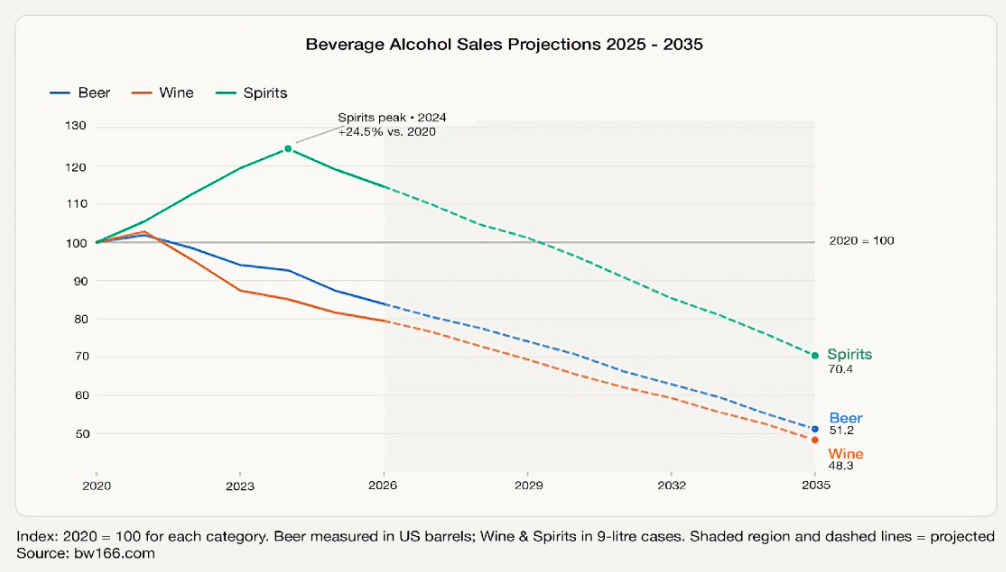
The above chart shows sales projections from bw166 to 2035 for the three major categories of beverage alcohol (spirits, wine and beer). It’s not a happy story. Spirits sales rose dramatically through the pandemic reaching their peak in 2024. Since then, they’ve been in a precipitous decline. While wine and beer sales also rose during the pandemic, they quickly began to subside as Covid fears began to ease.
According to NielsenIQ (NIQ), total U.S. beverage alcohol sales hit $9.3 billion in July while total annual retail and hospitality revenue for the U.S. alcoholic drinks market is projected at approximately $95 billion to over $110 billion. The economic impact goes further. If you include manufacturing, logistics and hospitality jobs, the industry’s impact rises to $363 billion. While small at near 2% of the total US consumer economy, it’s near 5% in total annual retail sales. That translates to around 4 million jobs, many of which are at risk in the diminishing sales of these industries.
What is being done to stem the decline?
During the past six months and over many years, I’ve attended countless seminars from these industries that have attempted to analyze the problem and encourage their members to do more. Beverage alcohol is beset by three major challenges that are not going away:
- The most obvious challenge is demographic, both at the top and bottom. Much of the wine and premium spirits business was built by Baby Boomers. Wine became both a social norm and a lifestyle. They fueled demand for premium bottles, wine tourism, tasting events, cellar programs, and subscription clubs. They became the industry’s most valuable customers. Now they are between 62 and 80 years old. As they age, natural attrition is shrinking the market.
At the younger end, many are drinking less frequently than they once did. Some are responding to health concerns. Others are managing chronic conditions or taking medications that discourage alcohol consumption. The rise of GLP-1 drug use among all consumers is affecting all categories of alcoholic beverage consumption. Alcohol simply occupies a smaller place in consumer lives than it did ten or twenty years ago.
- Marketers have assumed that younger consumers would eventually follow a similar path to prior cohorts. As Millennials aged, they would settle into established preferences. They would become loyal wine drinkers or loyal spirits drinkers. Their consumption patterns would mature much as previous generations had.
That’s an easily proved fallacy by simply watching how younger cohorts adopt their own lifestyle preferences. My father loved to listen to Benny Goodman, Mario Lanza (who?) and Sinatra. I know they were all great but as a Boomer I wanted to make my own choices. My kids are the same and today’s Millennial and Gen Z consumers are no different.
Millennials drink and so does Gen Z. But they move between categories in a way that would have been unusual twenty or thirty years ago. They might open a bottle of wine one night, meet friends for cocktails the following, drink craft beer on another occasion, and then spend several days drinking nothing alcoholic at all.
The distinction matters because the alcohol industry is still largely organized around categories. Producers think in terms of wine, beer, spirits, ready-to-drink beverages, and increasingly alcohol-free alternatives. Consumers, particularly younger consumers, often think in terms of occasions, moods, social settings, and personal needs. The category has become less important than the moment.
A generation ago, a winery competed primarily against other wineries. Today it competes for attention against virtually every beverage in the kitchen or drinking out. Craft beer, canned cocktails, flavored seltzers, premium coffees, energy drinks, kombuchas, functional beverages, and an expanding range of alcohol-free products are all competing for the same consumer.
- At the same time, the number of brands competing for attention has exploded. The U.S. is home to thousands of wineries, with imports adding even more, nearly 10,000 craft breweries, and a rapidly expanding spirits market. New products enter the market every year and distribution networks are eager to drop brands with flat or declining sales to latch onto the next growth story. Shelf space remains finite and consumer attention is even more limited. Recall White Claw’s explosive growth only a few years ago. The brand is still growing, but the formula that fueled growth has changed with new product innovations and releases. Even though the beverage alcohol market has become cluttered, continued introductions make it even more competitive.
Innovation while important creates its own set of problems. New packaging formats. New flavor profiles. New occasions. New categories. The rise of ready-to-drink beverages is one example. The growth of lower-alcohol products is another. Alcohol-free alternatives represent both the result of innovation and declining interest in traditional alcoholic drinks.
These three trends are not going away and none of them are things producers can control. What we’ve seen is more emailing, more discounts, more events, more promotions and more focus on consumers who visit tasting rooms. A lot of it is very creative but if it’s making a dent, it isn’t showing up, at least in the aggregate.
How a culture of inquiry can help?
I am an active DtC and wine/liquor store buyer. I subscribe to a lot of winery newsletters and I have yet to have any winery, spirit producer or brewery ask me a meaningful question. If I sign up on their websites to receive their communications, they ask for nothing more than my email address. If I sign up for their clubs, they ask nothing more than what varietals I like.
What do they understand about me? What do they understand about any consumer?
Nothing.
They may have tons of data including how much I’ve bought, when I’ve bought, how many and what emails I’ve opened, when I’ve opened, what I’ve clicked on and more. They may have geofenced the stores I go to or events I’ve attended. Still, they don’t know anything about my beliefs, interests, needs or perceptions. Most importantly, they don’t know why I believe what I do.
Yet, every single interaction with a consumer is an opportunity to inquire about the things they don’t know and build a relationship that can translate into brand loyalty. The mistake is to believe your own promotion thinking that your concerns are also those of your customers. That’s an internal bias that says you’re not listening. Even when producers recognize that younger consumers are thinking about the moment and not the wine, they tend to prescribe what’s important.
There’s a simple progression to a system built on inquiry: (1) ask continuously, at every opportunity; (2) record their responses, particularly the language they use; (3) append their responses to their data files; (4) segment by interest, need, perception and more (never by the aggregate); (5) respond by segment; and, (6) repeat. The goal is to gain understanding and acknowledge that you’re listening. It’s recognizing that relationships build transactions and that transactions don’t build relationships.
This is not market research as it’s traditionally thought. It’s a repetitive inquiry system that functions off of dozens of closed- and open-ended inputs, all pointed to maximizing customer lifetime value. You can build it, or you can subscribe to ours but the important point is inculcating a culture of asking consumers what, when and why wherever you can – digitally but also in-person.
If that doesn’t make sense to you, think about your best friends. You’ve probably known them for years. You understand what they like, how they spend their time and why. You’ve asked each other dozens of questions. You know their views and beliefs and all that knowledge makes your friendships successful. Customer relationships are no different. The best ones result from taking more of an interest than just in what they do.
This distinction is becoming increasingly important because the economics of customer acquisition are changing. Finding new customers has become more expensive. Retaining existing ones has become more important. Growing customer lifetime value increasingly depends on understanding individuals rather than broad demographic groups.
For years, marketing technology promised better targeting, but better tracking is not better targeting. A shift to inquiry can prove especially important for beverage alcohol producers. You shouldn’t expect or want every customer to think the same way. Producers need to understand how they and their products resonate with which audiences and recognize that a purchase decision is not always related to the product itself.
The industry’s future will depend less on creating new products than on creating stronger relationships with the people who already care. Innovation will continue, but the companies that build lasting growth are likely to be those that develop a deeper understanding of who their customers are, what they care about, and why they make the choices they do.
In a marketplace where loyalty has become harder to earn and easier to lose, understanding may be the most valuable competitive advantage left.
I’d love to hear your comments and if you’d like to know more Oomiji, take a look at our capabilities brochure.